
Park rangers and residents speak up to save Togo’s last national park

08 October, 2026
By Nico Arcilla
This article was originally published by Science X Dialog at Phys.org.
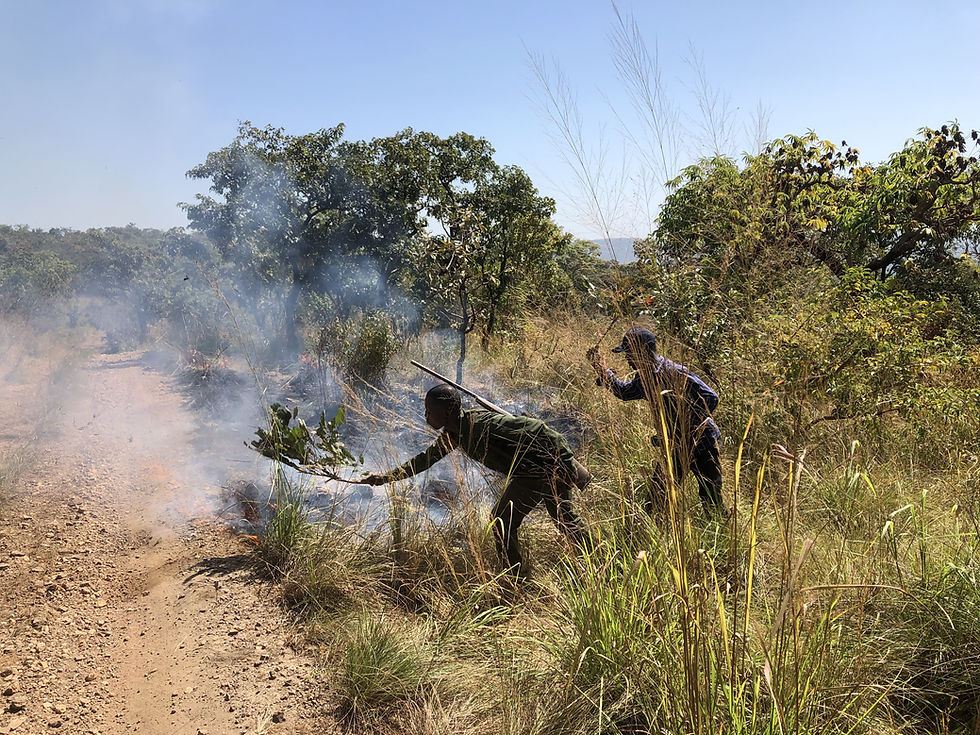
Park ranger Nabagma Nambila and Lin-Ernni Kaboumba put out fires set by poachers in Fazao-Malfakassa National Park. Photo by Nico Arcilla.
A few years ago, I drove with an old friend from Togo, West Africa, towards the country’s last remaining large protected area, Fazao-Malfakassa National Park. Our destination was the Hotel Fazao, where his uncle had once worked as a professional chef after its opening in 1980. For decades, while the park was managed by the Swiss Franz Weber Foundation (FWF), the hotel had hosted tourists from around the world who came to see elephants, monkeys, and other wildlife for which Africa is famous.

Fazao-Malfakassa National Park is the last place in Togo where endangered African elephants (Loxodonta africana) survive. Photo by Nico Arcilla.
Everything changed, however, in 2015, with the departure of the foundation after Togo’s government decided to resume control of the park’s management, and we weren’t sure if the hotel was still operating. When we arrived, we were shocked to found the hotel a ruin, its rooms broken into and looted, the swimming pool now used to wash motorcycles while herds of goats lounged on the patio. How do the park’s rangers and residents feel about the park’s dramatic shift from private to state management?

A view of the abandoned Hotel Fazao, with goats visiting the swimming pool. Photo by Nico Arcilla.
Together with Togolese and American colleagues, we conducted interviews with 42 park rangers and 400 residents in and around Fazao-Malfakassa National Park, and published the results in the journal Wild. Park rangers ranged from 25 to 55 years old, with histories with the park ranging from 2 to 25 years; 40% of them had experience with both private and state management. All rangers with experience of private management viewed it as “good” or “very good,” whereas most rangers (83%) rated the state’s management as “bad” or “very bad.” Following the shift from private to state management, rangers reported increased poaching and other illegal activities.

The Western Kob (Kobus kob kob) is one of hundreds of wildlife species that should be protected in Fazao-Malfakassa National Park, but this unfortunate victim of widespread poaching was one of many casualties of the park’s shift from private to state management. Photo courtesy of Nico Arcilla.
According to rangers, wildlife poaching, honey poaching, illegal burning, and cattle grazing were the illegal activities they encountered most frequently in the park’s interior. Nearly a third (31%) of rangers reported fearing retaliation from those whom they arrested, who were often quickly released. Most rangers (88%) reported that greater respect existed for FWF rangers compared to rangers employed by the state. Since the departure of FWF, all rangers reported receiving their monthly pay irregularly, having to use their personal vehicles for surveillance, and having to cover the costs of fuel and repairs themselves.

Fazao-Malfakassa National Park sign posted by the Franz Weber Foundation to show the prohibition on cattle herding in the park. Photo by Nico Arcilla.
West Africa hosts exceptionally high linguistic diversity, and residents in and around the park speak 22 different languages, representing over half of Togo’s approximately 40 ethnic groups. At the time of our research, ~58,000 people were living in 59 villages in and around the park. We interviewed 400 residents from 16 villages in and around the park, ranging from 18 to 101 years old. Most residents interviewed (79%) were farmers or caregivers. Of the majority (79%) who had experience of both private and state management of the park, most (88%) rated FWF’s management as “good” or “very good,” while nearly two-thirds (64%) of residents interviewed perceived the state’s management as “bad” or “very bad.” A significant majority of residents interviewed (79%) felt that FWF had managed the park better than the government.

Fulani cattle herders and their cattle near Kalaré station in Fazao-Malfakassa National Park. Photos by Nico Arcilla (left) and Abiola Sylvestre Chaffra (right).
Officially, Togo has 83 protected areas, but many, if not most, can be considered “paper parks” that have little to no protection in reality. Until recently, Fazao-Malfakassa National Park has been the exception, providing the last refuge for critically endangered species in Togo including the African forest elephant and ursine colobus, endangered raptors including the Martial Eagle and Bateleur, and other charismatic and globally threatened species such as the Abyssinian Ground-Hornbill. However, as an island of nature surrounded on all sides by human-dominated landscapes, the park is highly vulnerable,

Evergreen riparian forest near Malfakassa in Fazao-Malfakassa National Park, Togo. Photo by Nico Arcilla.
Poaching has devastated wildlife populations and illegal activities have driven significant habitat loss in the park, threatening to destroy what remains of the park in the foreseeable future. In our experience, most of the perpetrators of illegal activities are not local residents, but people who have traveled considerable distances, or even crossed international borders, to exploit the park’s resources. Moreover, they are often participants in organized crime for elite capture, such as the multimillion-dollar illegal charcoal industry, enriching cartel bosses at the expense of the rural poor.

Former forest reduced to charcoal in Fazao-Malfakassa National Park. Photo by Stephanie Bartlett.
Residents recommended park staff crack down on illegal activities, specifically poaching and logging, hire more rangers, and invest in village infrastructure. To improve park management, rangers recommended providing staff resources to conduct patrols, including motorcycles (70%), uniforms and boots in good condition (48%), better firearms (45%), and fuel for service vehicles (36%). Current ranger salaries are below the poverty level, and to resolve this, higher salaries were also highly recommended (93%).

A former community forest in Fazao-Malfakassa National Park cleared for agriculture after it was illegally sold to a developer. Photo by Nico Arcilla.
Effective ranger patrols can make the difference between a paper park and a working protected areas that conserves biodiversity and provides economic benefits through ecotourism. Before the destruction of Togo’s northern protected areas by anti-government militias in 1990-1991, ecotourism brought in ~USD1.2–1.4 million annually. The government closed Fazao-Malfakassa National Park to tourism following the departure of FWF in 2015. All park rangers and almost all residents (98%) wanted tourism to return to the park, and almost all (98%) reported that members of their community would be willing to work for the park.

Bird researchers Abiola Sylvestre Chaffra, Yendboubouam Kourdjouak, and Lin-Ernni Kaboumba near Mont Kpéya in the center of Fazao-Malfakassa National Park. Photo by Nico Arcilla.
All rangers who had worked under both management systems preferred private to state management, and no rangers supported continued state management unless specific changes were implemented. Most park rangers (89%) recommended returning the park either to private management in cooperation with the government. Over two and a half times more residents recommended private management over state management. In neighboring Benin, national parks deteriorated under government management but considerably improved following their transfer to private management, and similar successes abound in the region, such as Cameroon, Chad, and the Central African Republic.

Mont Kpéya in the center of Fazao-Malfakassa National Park. Photo by Nico Arcilla.
Park rangers and residents are on the front lines of conservation, but too often their voices are not heard. In Togo, they speak many languages, but their voices are united in the desire to save their last national park from destruction. Now that the people have spoken, we urge Togo’s leaders to take decisive action in time to heed their will, and save this irreplaceable national park for Togo’s children and future.

Boulohou waterfall in the dry season in Fazao-Malfakassa National Park. Photo by Stephanie Bartlett.
Bio:
Nico Arcilla is president and research director of the International Bird Conservation Partnership (IBCP), which fosters and supports research, education and partnerships that promote bird conservation worldwide. She earned a BA from Yale University, MS from Cornell University, and a PhD from the University of Georgia. An affiliate fellow at the University of Nebraska-Lincoln. she has co-authored more than 50 peer-reviewed scientific articles on avian ecology and conservation.
A view of the Fazao Mountains on the western side of Fazao-Malfakassa National Park. Photo by Stephanie Bartlett.


Comments