
A bird’s eye view of illegal logging and its consequences in the Peruvian Amazon

2 September, 2026
By Nico Arcilla
This article was originally published by Science X Dialog at Phys.org.

Yellow-margined Flatbill (Tolmomyias assimilis) is insectivorous, often foraging in mixed-species flocks and often catching prey by sallying or hover-gleaning from undersides of leaves. Photo by Nico Arcilla.
When I first arrived in Peru’s Allpahuayo-Mishana National Reserve in 2005, a local youth surprised me with an offer to sell me a live owl, despite the fact that we were in a protected area where commercial hunting was prohibited. We set the owl free together, but this turned out to be an early lesson about the vulnerability of tropical protected areas to exploitation, even when laws and policies had been put in place to protect them. At that time, Allpahuayo-Mishana was a newly designated protected area with no paid staff except for its director, who was stationed in the nearby city of Iquitos.

A sign marks an entrance in Allpahuayo-Mishana National Reserve, Peru. Photo by Nico Arcilla.
Almost a third of the world’s bird species depend on tropical forests for survival, and in turn play critical roles, such as pollinators and seed dispersers, to maintain forest structure and function. Western Amazonia harbors the highest bird species richness in the world, and Peru’s Allpahuayo-Mishana National Reserve protects rare white-sand forests and nearly 600 bird species on 576 km2 of land on the north bank of the Amazon River.

Purple Honeycreeper (Cyanerpes caeruleus; female) is omnivorous, feeding on beetles, ants, and other arthropods, as well as small fruits and nectar. Photo by Nico Arcilla.
Unfortunately, however, Peru is subject to one of the world’s highest rates of deforestation, driven largely by illegal logging, which destroys forests, harms people and wildlife, and is associated with steep declines in bird populations. Illegal logging is a major threat to tropical protected areas around the world. The consequences of illegal logging for birds and forests in Allpahuayo-Mishana are the subject of an article my colleagues and I published in Land.

Illegal logging for resort construction in Allpahuayo-Mishana National Reserve. Photo by Nico Arcilla.
We sampled birds with mist nets, capturing and releasing birds in unlogged forests as well as forests logged 1, 5, and 9 years previously. We compared understory bird communities in forests with different logging histories and any correlations with habitat structure variables. We also took advantage of a rare opportunity to compare bird sampling data collected at the same forest sites in 2005 and 2023, in order to investigate changes in understory bird communities over this 18-year period.

Elegant Woodcreeper (Xiphorhynchus elegans) is one of nearly 600 bird species protected by the Allpahuayo-Mishana National Reserve. Photo by Nico Arcilla.
Our results show that illegal logging has had a significant influence on forest structure in Allpahuayo-Mishana, with consequences for birds that persist for decades after logging events. Average bird species richness in unlogged forests was ~52 species, whereas one year after logging, bird species richness had declined by over 50% (~25 species).

Study are in Allpahuayo-Mishana National Reserve. Map by Alex Glass.
However, by ~5 years after logging, bird species richness had increased to an estimated ~102 species, nearly twice that in unlogged forest. ~9 years after logging, bird species richness then declined to ~34 species, or approximately one-third that of unlogged forest. As part of our investigation, we classified understory bird into guilds based on their main foraging strategies.

Pearly Antshrike (Megastictus margaritatus). Photo by Nico Arcilla.
Ant followers accompany army ant swarms to forage on arthropods as they flee to escape becoming prey to the ants; other insectivores also hunt arthropods using strategies such as flycatching and gleaning from leaves and bark. Frugivoresprimarily consume berries and other fleshy fruits, granivores consume seeds, nectarivores consume flower nectar, and omnivores include birds assessed in multiple foraging categories.
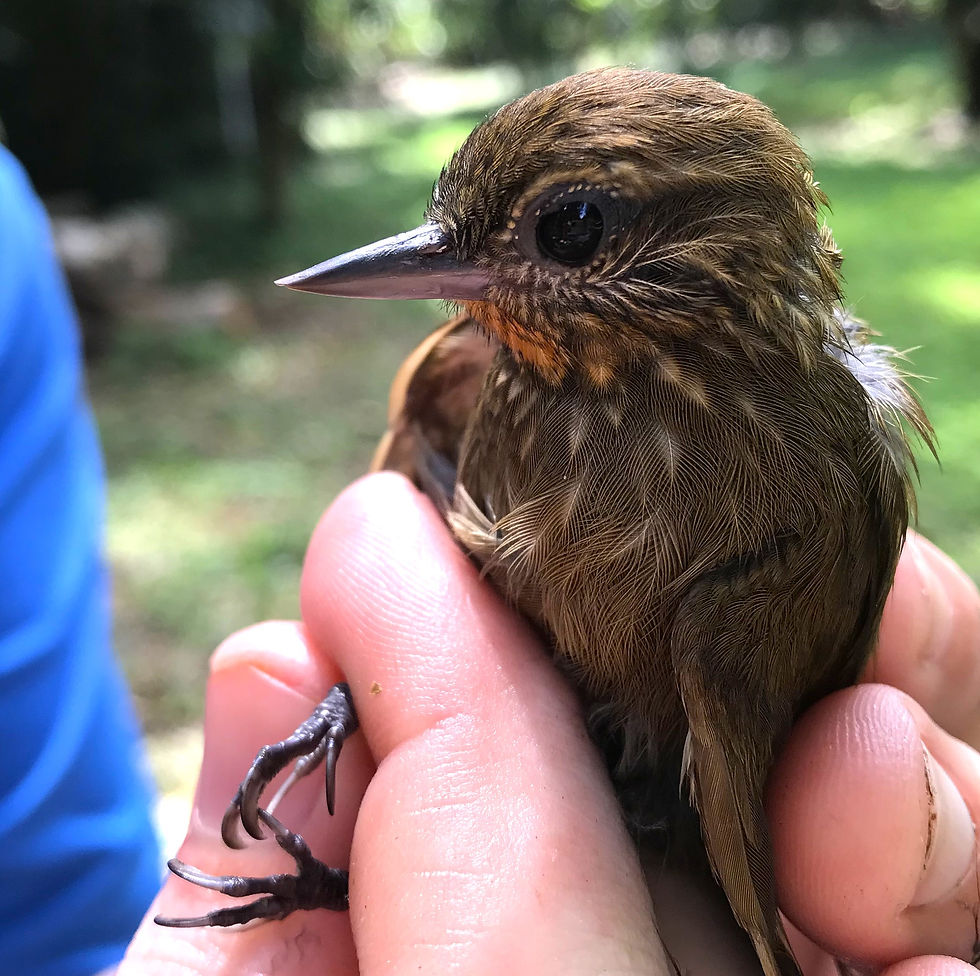
Wedge-billed Woodcreeper (Glyphorynchus spirurus) forages for arthropods, often in mixed-species flocks, but almost never associates with army ant swarms. Photo by Nico Arcilla.
Frugivores demonstrated the greatest changes in relative abundance following logging, significantly declining following logging but increased over time since logging in regenerating forests, a pattern also demonstrated by nectarivores. We found that ant follower abundance declined with herbaceous ground cover and average tree diameter, and increased with leaf litter, subcanopy cover, and canopy cover.

Social Flycatcher (Myiozetetes similis). Photo by Nico Arcilla.
Other insectivores likewise increased with canopy cover but declined with the number of trees. By contrast, frugivore abundance increased with the number of trees and average tree diameter. Granivores increased with subcanopy cover, while nectarivores declined with subcanopy cover and the number of trees, but increased with average tree diameter.

An opening in white-sand forest in the Allpahuayo-Mishana National Reserve, receiving a visit from a rainbow. Photo by Nico Arcilla.
The time to full recovery of forest bird communities following logging events is unknown, as are the consequences for white-sand forest birds’ evolution. However, we were able to assess bird communities at forest sites logged up to 27 years previously as part of a related field research project conducted in 2023. Between 2005 and 2023, overall understory bird abundance, as measured by capture rates, declined by ~20%, and frugivores declined even more steeply, by ~25%. Ant followers declined yet more steeply, by ~33%, presumably due in part to decreased army ant activity in logged forests. Using our findings from this study, we can speculate that these declines may have occurred in association with increased herbaceous ground cover and decreased leaf litter following logging operations, as well as declines in the numbers and sizes of trees.

Ruddy Spinetail (Synallaxis rutilans). Photo by Nico Arcilla.
While numbers of ant followers declined by a third over this 18-year period, numbers of other insectivores increased by nearly two-thirds, a change possibly facilitated by increased canopy cover in recovering forests. Declines in understory bird species richness and/or abundance due to the loss of interior forest species from logged forests may be offset by increases of forest habitat generalist bird species in recovering logged forests, while forest specialist species, such birds associated with army ants, may decline or disappear.

Cinereous Antshrike (Thamnomanes caesius). Photo by Nico Arcilla.
Illegal logging impacts on birds in the forest stands we studied may have been mitigated by the larger primary forest landscape surrounding logged patches. Thus, our estimates of logging damage must be interpreted conservatively, as logged forest patches in this study were small and surrounded by unlogged forest.

Ruddy-tailed Flycatcher (Terenotriccus erythrurus). Photo by Nico Arcilla.
When I returned to Allpahuayo-Mishana National Reserve in 2023, I was in for another surprise. The reserve is now the focus of an ayahuasca tourism boom, where visitors pay to have psychedelic experiences using Amazonian plants, often under the supervision of Shipibo shamans who have immigrated to the reserve from Peru’s central Ucayali region for this purpose.

Logging near an expanding ayahuasca retreat center in Allpahuayo-Mishana National Reserve. Photo by Nico Arcilla.
While these activities are marketed as environmentally friendly indigenous traditions, in reality they are associated with ongoing illegal logging and forest destruction in this fragile protected area, and most of those running and profiting from these operations, including the Shipibo shamans, are not from this area. Unfortunately, illegal logging thus continues to threaten birds and ecosystems in Allpahuayo-Mishana and other tropical protected areas. We hope that ongoing research, monitoring, and conservation efforts in the reserve will mitigate negative human impacts on the forests and biodiversity the reserve was designed to protect.

Yellow-crowned Tyrannulet (Tyrannulus elatus). Photo by Nico Arcilla.


Comments