
Belief-based use increasing threat to yellow-billed kite, an important African scavenger

8 July, 2026
By Sean Mowbray
Original article:https://news.mongabay.com/2026/07/belief-based-use-increasing-threat-to-yellow-billed-kite-an-important-african-scavenger/

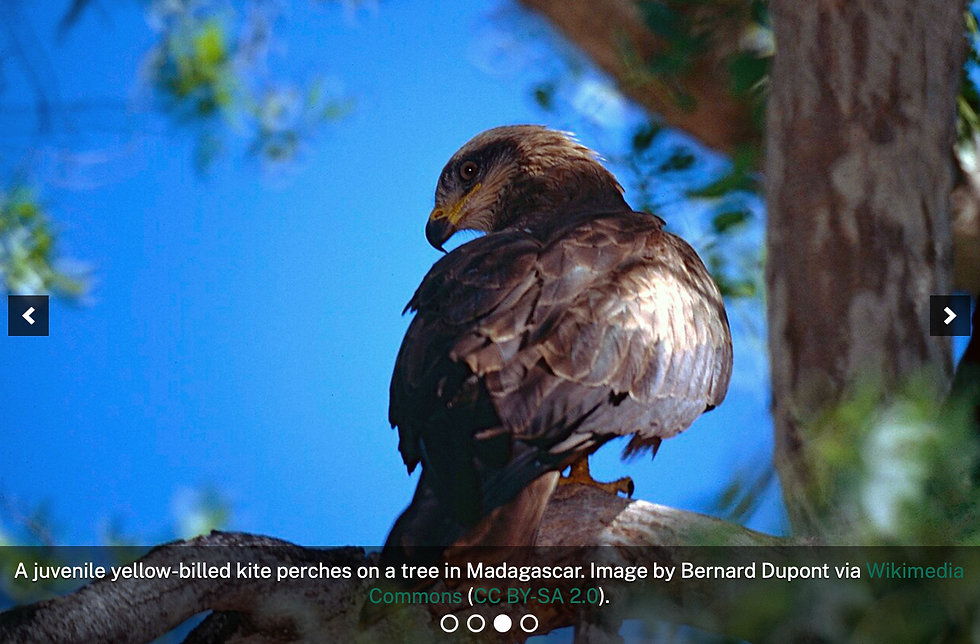
Yellow-billed kites are found across Africa and play an important role in keeping ecosystems healthy as one of the most common scavengers. Image by Bernard DUPONT via Wikimedia Commons (CC BY-SA 2.0).
Yellow-billed kites are widespread across Africa. But conservationists warn that in the absence of heavily-hunted vultures, this bird is now targeted for use in belief-based rituals in West Africa.
A survey spanning two hunting seasons in southern Benin estimated that more than 20,000 yellow-billed kites were poached for consumption and for sale in fetish markets. Researchers tallied nearly 2,000 birds for sale in markets.
Poaching is also occurring in neighboring Togo and Nigeria.
Experts are concerned that at this scale, poaching could quickly lead to population-level declines. They urge action to control hunting and sale of this bird.
With West Africa’s vulture populations dwindling, poachers are increasingly turning to yellow-billed kites, a medium-sized, extremely adaptable raptor found in nearly every landscape across much of sub-Saharan Africa. And though they are listed as a “least concern” species on the IUCN Red List of Threatened Species, they face a growing threat: They’re more frequently hunted for use as fetishes and for food.
Like vultures, kites — both alive and dead — and their parts are used in rituals and as charms. They’re caught as bushmeat, supply fetish markets and are used as ingredients in local traditional medicine.
A study by Abiola Chaffra, a research fellow at the International Bird Conservation Partnership, found that during November-to-March hunting seasons in 2022 and 2023, hunters killed 20,200 yellow-billed kites (Milvus aegyptius) in southern Benin.
They flock from across Africa to nest and breed in southern Benin each year, and as soon as they arrive, they’re in danger. “[These hunts occur] every year because the kites always come back,” Chaffra told Mongabay. The research will be published in the bulletin of the African Bird Club.
Their loss could have broad impact: Yellow-billed kites are opportunistic predators that eat a wide range of small mammals, amphibians and insects that are considered pests. They play a key role in cleansing landscapes of disease and scavenging carcasses.
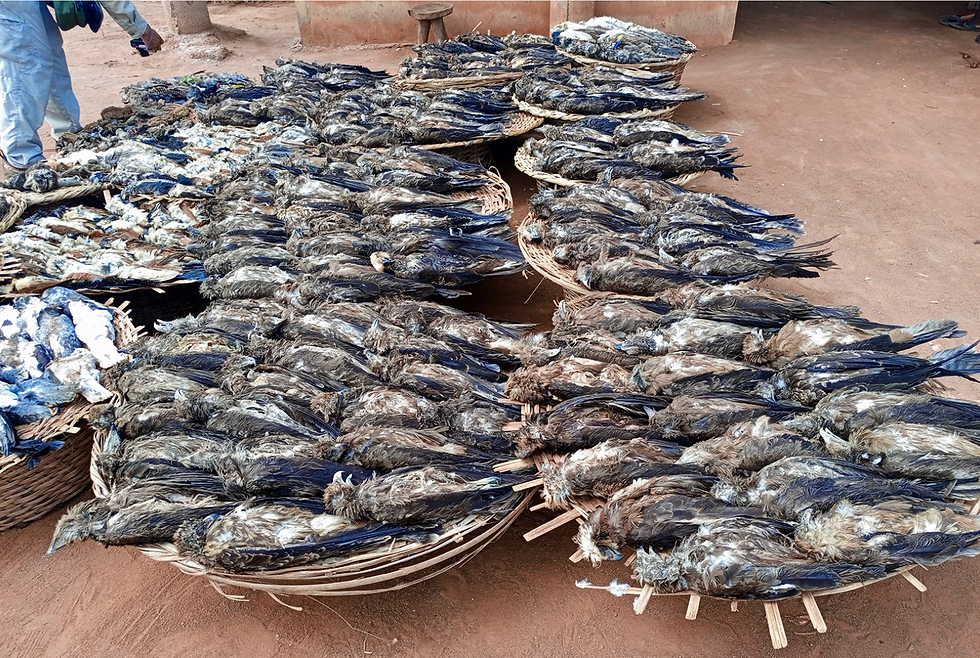
Yellow-billed kites at a fetish market in Benin. Image by Abiola Chaffra.
Belief-based demand
Raptors have long been used in rituals in Benin, but it appears to be increasing, Chaffra said. His research found that yellow-billed kites are also hunted and sold in markets in neighboring Togo and trafficked into Benin.
It’s partly a domino effect. Hooded vultures (Necrosyrtes monachus) have been hunted to near-extinction in the region, sold to belief-based users for ritual use: Some believe they have magical superpowers.
“This means that the demand for vultures is so high that the species is becoming rare, and yellow-billed kites are [being] used as substitutes,” Chaffra said.
Like hooded vultures, they frequently dwell near human populations. That makes them “exceptionally vulnerable” to targeted killing, Ralph Buij, a senior scientist with the Peregrine Fund, wrote in an email to Mongabay.
The latest IUCN assessment in 2021 described yellow-billed kites as probably the most common large raptor in Africa. That analysis, however, didn’t include threats posed by growing belief-based use or consumption.
Visiting seven fetish markets in Benin in February 2024, Chaffra counted nearly 2,000 of the birds for sale, some alive, some dead and others in parts. Some had their necks and heads shaved, advertised as hooded vultures. Chicks were also present.
“Those numbers are staggering to me, even in light of the almost complete lack of enforcement, the corruption, and especially, the perceived values and economic incentives driving this trade,” Buij wrote.
He’s followed commerce in raptors for more than 27 years. His research, published in 2015 in the journal Oryx, found widespread sale of kites and other raptors in markets across Central and West Africa. Data from 1999 to 2013 showed a “steady, rising proportion of kites” for sale in Benin and Nigeria. Another species, the black kite (Milvus migrans) that migrates from Europe, is likely also targeted.
“Trade does not appear to have slowed down, but rather appears to have accelerated,” he said. “Recent market data confirms that kites are heavily exploited as targets for belief-based use and increasingly serve as commercial substitutes for rapidly collapsing vulture populations.”
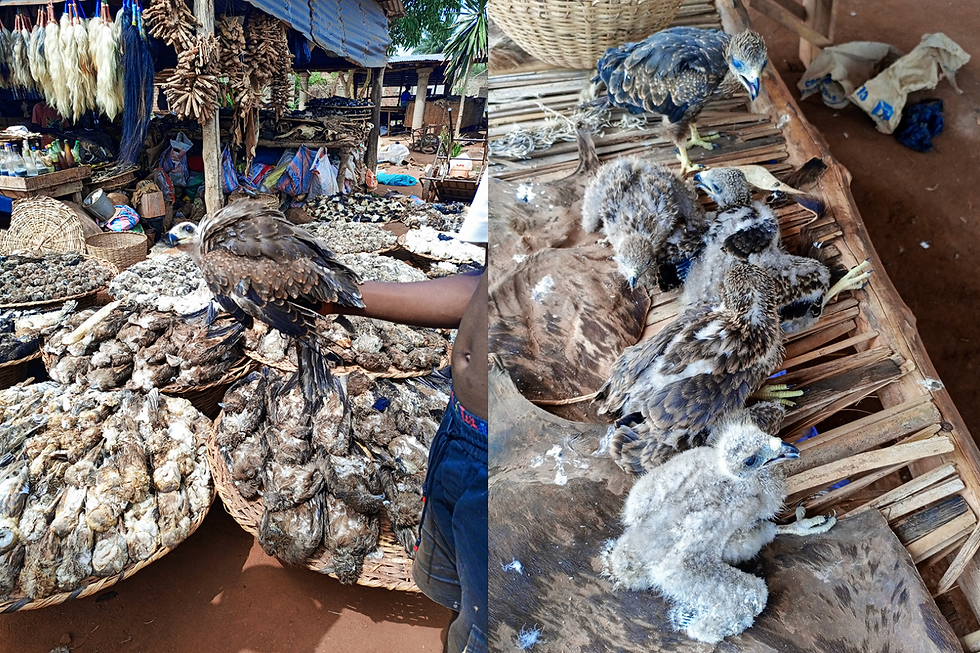
(Left) A man displays a yellow-billed kite at a wildlife market. (Right) Yellow-billed kite chicks for sale at an outdoor market. Images by Abiola Chaffra.

Belief-based demand represents a severe threat to yellow-billed kites, experts say. Image by peymanz via Flickr (CC BY 2.0).
A ‘quite disturbing’ trend
A similar trend is occurring in Nigeria as it battles with its own belief-based market that has collapsed vulture populations there. Once home to seven species, the country now only hosts two — hooded and palm-nut vultures (Gypohierax angolensis) — according to recent surveys.
Michael Manja Williams, a Ph.D. candidate at Nigeria’s Joseph Sarwuan Tarka University, have witnessed hunts with his team. They observed groups of hunters targeting yellow-billed kites, particularly in areas where vultures are absent. He described the trend as “quite disturbing.”
He said this has similar hallmarks of how large-scale vulture poaching began in Nigeria. “What happened to the vulture may happen to the yellow-billed kite, because the vulture [trade] started like that,” he said. “We have a lot of yellow-billed kites now [but] if this trajectory of hunting goes on, we might not have them in the near future.”
For now, yellow-billed kites remain abundant and widespread across their range. The last assessment found that southern Africa’s population appeared to be increasing.
While there is not an immediate short-term concern for the species’ extinction, the situation needs close monitoring, said Rob Martin, who serves as Red List team manager at the nonprofit BirdLife International.
In his soon-to-be published paper, Chaffra warned that the current level of offtake could push the species into a vulnerable conservation status.
“The numbers involved are certainly sufficient to be having population level impacts, especially if it’s including a proportion of adult birds,” Martin told Mongabay in an interview. “Unsustainable killing of large birds for belief-based use is also affecting other raptors: Hornbills, cranes, storks and ibises.”
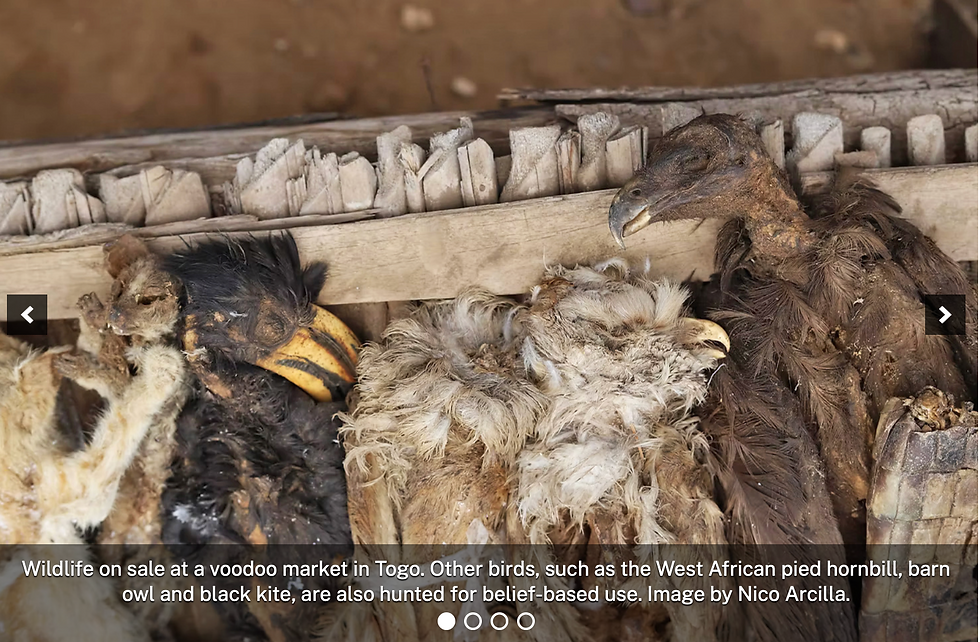


Conservationists urge immediate action including more vigilant enforcement. But better policing alone won’t stem the trade. Researchers say that campaigns targeting traditional practitioners are needed to address demand, and awareness-raising workshops could help tackle poaching of yellow-billed kites and other raptors for belief-based use.
Tracking the birds could offer invaluable information as well. Chaffra said yellow-billed kites in Benin should be tagged to understand where the birds originate and how hunting is affecting populations.
“It is time for Benin to step up its actions against the brutal trade of steeply declining raptors,” Buij wrote. “We must act immediately while continuing to monitor the trade, and I call on the Beninese government and regional NGOs to elevate raptor conservation to a major environmental priority before localized extinctions become irreversible.”



Comments