
Lost bird found: Ghana Cuckooshrike documented in Taï National Park, Ivory Coast

Updated: Jul 25
20 July, 2026
By David Goodman

Ghana Cuckooshrike (Lobotos lobatus) in Taï National Park, Ivory Coast. Photo by Stephanie Bartlett.
The Upper Guinea rainforests of West Africa once stretched unbroken across five countries. Today, only a fifth of that primeval tract remains, scattered in fragments and besieged on every side by logging concessions, agricultural plantations, and expanding settlements. Taï National Park, Ivory Coast, is one of its last strongholds, a UNESCO World Heritage site and block of habitat so impenetrable that much of what lives inside it has never been properly documented. Taï is home to one of the largest chimpanzee troupes in the world, and is one of the last places in West Africa where the tracks of forest elephants still crisscross the understory.

The Western Red Colobus (Piliocolobus badius) is one of many endangered species protected by Taï National Park. Photo by Stephanie Bartlett.
Many rare rainforest endemic species that have been wiped out across the vast majority of their former ranges find their last refuge here. Recently, IBCP field researchers Stephanie Bartlett and Paulo Ditzel spent several weeks in and around this stretch of wilderness, together with Félix Houphouët-Boigny University Professor Saint Guillaume Odoukpe, PhD researcher Lin-Ernni Mikégraba Kaboumba and IBCP’s West Africa Project Manager Yendoubouam Kourdjouak.

Stephanie Bartlett and Paulo Ditzel photographing an Orange-breasted Forest Robin (Stiphrornis erythrothorax) they captured and released in Taï National Park. Photo by Lin-Ernni Mikégraba Kaboumba.
The IBCP team spent many days trying to reach less-trafficked parts of the forest, bushwhacking through miles of abandoned cacao plantations, negotiating with park guards, circumventing unnavigable rivers, and bouncing for hours down treacherous roads in search of habitat untouched by humans. Taï holds species difficult or impossible to find elsewhere precisely because of this inaccessibility; some parts of the park are nearly impossible to reach even with significant effort. Their time in Taï would mark the final weeks of Stephanie and Paulo’s six-month field stint in West Africa. The team’s mission was to scout sites for ongoing and future research projects on hornbills and forest understory birds in the park.
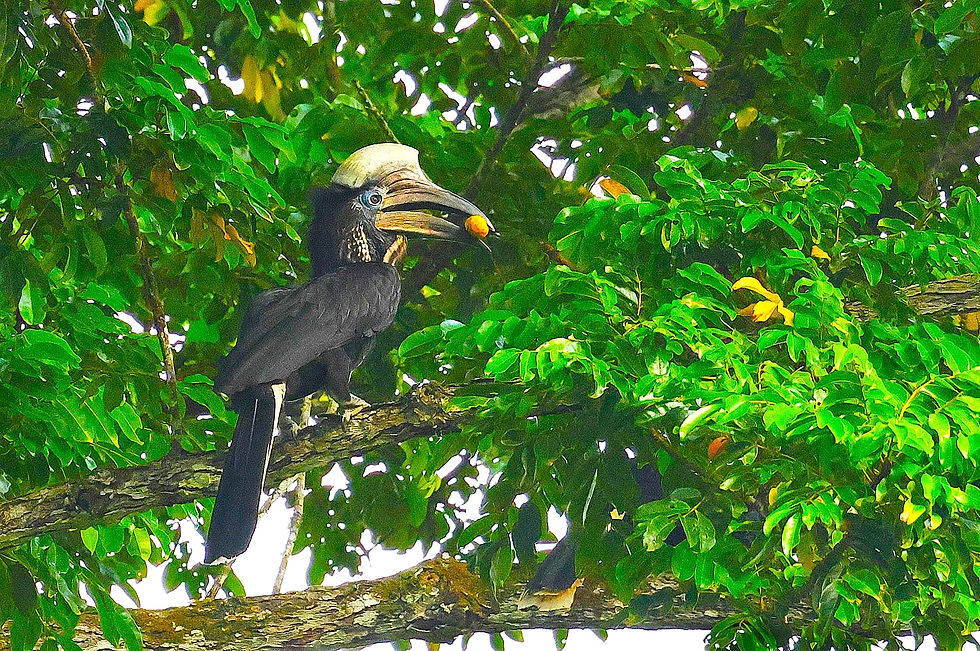
The Yellow-casqued Hornbill (Ceratogymna elata) is one of many range-restricted species in West Africa recognized as vulnerable to extinction. Photo by Stephanie Bartlett.
Once they learned they'd be traveling here, Stephanie and Paulo began joking about the chance of seeing a "lost bird." The Search for Lost Birds is a collaborative project to locate and document all bird species on earth that have not been confirmed for at least 10 years in the form of photographs, video, audio, or genetic evidence. Established by the American Bird Conservancy, Re:wild, and BirdLife International, and supported by the platform Birds of the World, the project requested assistance in finding and documenting several lost birds in West Africa, including the Ghana Cuckooshrike.

Yendoubouam Kourdjouak navigates driving over a heavily damaged bridge across a river at the edge of Taï National Park. Photo by Stephanie Bartlett.
The idea of seeing one wasn't impossible. Sightings had trickled in across the decades. G. Field logged twenty encounters in the Gola Forest, Sierra Leone, between 1971 and 1976, and Olivier Lachenaud observed small groups near Divo, southern Ivory Coast, in 1999. Then the species was photographed in Ghana, in Kakum National Park in 2010 and again in Atewa Forest Reserve in 2013, but there had been no confirmed sightings since then. Particularly concerning for the Ghana Cuckooshrike and other African endemic species that depend on intact rainforests for survival is the ongoing destruction and fragmentation of West Africa’s remaining rainforests.

Young Chocolate-backed Kingfisher (Halcyon badia), one of hundreds of rainforest-dependent African endemic species protected by Taï National Park. Photo by Stephanie Bartlett.
Despite the recognition of these forests as part of a global priority biodiversity hotspot, their destruction has continued and even accelerated across much of their former extent. Unprecedented human population growth in the region has driven the ongoing destruction of formerly wild and natural areas, including protected areas, for conversion to human use. Most of what once was native rainforest is now commercial agriculture, especially plantations of cacao trees (Theobroma cacao), from which cocoa beans are harvested to make chocolate. The Ivory Coast is the world’s top exporter of cocoa and together with Ghana accounts for two thirds of the world’s cocoa production.

Extinct or nearly extinct in much of their former range, Great Blue Turacos (Corythaeola cristata) thrive in Taï National Park. Photo by Stephanie Bartlett.
Unfortunately, the region’s forests and wildlife have paid an enormous price for this massive transformation. Research in Ghana, for example, revealed that more than 50% of the country’s rainforest birds have been lost to recent deforestation, which continues unabated. Remaining rainforest in the Ivory Coast is also under heavy pressure, and Taï National Park hosts the vast majority of the remaining rainforest in the country. In theory, Taï was the perfect place to see the Ghana Cuckooshrike, squarely within its range. There had even been recent reports of this species in Taï, including one as recently as 2026, but none included any documentation, making them difficult to confirm.

Paulo Ditzel, Lin-Ernni Mikégraba Kaboumba, and Yendoubouam Kourdjouak crossing a river inside Taï National Park. Photo by Stephanie Bartlett.
With no confirmed sightings of a Ghana Cuckooshrike in 13 years, they knew the odds of seeing one weren't in their favor. After a long day of hiking and driving, the team reached a research station used mainly as a base for field studies of chimpanzees, a small collection of buildings in dire need of repairs. Shortly after their arrival, Stephanie and Paulo set out to explore the trails, while the rest of the team stayed at the research station. Ten minutes into their walk, on a wooden footbridge over a small stream, Paulo looked up. An eye trained by years of ornithology work and months in West Africa immediately caught sight of the bird the two of them had dreamed of seeing.
"Cuckooshrike, cuckooshrike, cuckooshrike!" he hissed to Stephanie in an urgent whisper. The lost bird was right above them, foraging low enough in the canopy to be seen.

Ghana Cuckooshrike. Photo by Stephanie Bartlett.
Seeing the bird would have been remarkable enough on its own, but without documentation it wouldn't mean as much to science. Stephanie, a skilled photographer, already had her camera ready, and quickly captured the highest-quality photos ever taken of the species along with the first known video of it. Paulo then sprinted for the rest of the team, arriving at the station sweaty and winded, shouting in French "There's a cuckooshrike down the trail!" By the time the rest of the team had reached the little wooden bridge, however, the elusive bird had vanished.

The bridge from which the Ghana Cuckooshrike was seen. Photo by Paulo Ditzel.
Part of what makes the cuckooshrike so difficult to spot is its habit of staying 20 to 50 meters high, in the crowns of the tallest trees, moving with mixed-species flocks in near total silence. No one has ever obtained an audio recording of it. In a forest where the canopy is a green ceiling and the birds above it are silhouettes, even an unmistakable orange wattle is easy to miss without a sharp eye and a great deal of luck.

Forest canopy where the Ghana Cuckooshrike was seen in Taï National Park. Photo by Paulo Ditzel.
Afterward, Paulo and Stephanie were desperate to tell their supervisor, Nico Arcilla of IBCP, but that part of Taï had no cell service. Luckily, a group of researchers before them had already solved the problem with the kind of ingenious, bootstrap solution so typical of fieldwork: find a tall tree, shoot a rope into the canopy with a bow and arrow, and rig a pulley. Stephanie and Paulo wrote up their message, attached photo proof, sealed the phone in a plastic bottle, and hauled it above the canopy to catch a moment of signal long enough to send it.
The Ghana Cuckooshrike, filmed for the first time. Video by Stephanie Bartlett.
Nico was elated to get the news. “We were sitting down at the dinner table when the message came through,” she noted, “and suddenly, we’re looking at a photo of this beautiful bird, this lost bird they had just found. It was such a wonderful surprise!” Nico sent the news and photo on to John Mittermeier of the Search for Lost Birds and the American Bird Conservancy while the research team remained in Taï, largely out of reach of communication.

The research team in Taï National Park, including, from left to right: Lin-Ernni Mikégraba Kaboumba, Yendoubouam Kourdjouak, Taï ranger Évariste, Stephanie Bartlett, Paulo Ditzel, and Saint Guillaume Odoukpe. Photo by Paulo Ditzel.
The appearance of the Ghana Cuckooshrike provided one of the happiest surprises of Paulo and Stephanie’s six months in West Africa. It followed a great many other surprises, many of which unfortunately were not happy ones. They had encountered poachers in supposedly sacred areas and seen how illegal industrial-scale charcoal operations incinerated forests and everything in them, along with huge herds of cattle consuming and trampling habitat in what are supposed to be protected lands. In Benin, they had to cut short bird research in a sacred forest after a dispute between two villages over the forest’s management. In Ghana, they were unable to access Atewa Forest Reserve, the site of a previous cuckooshrike sighting, as it is currently threatened by a mining project. In Togo, they had to evacuate one part of a national park after reports of a possible terrorist weapons cache in a remote area!

A poacher camp in Taï National Park. Photo by Lin-Ernni Mikégraba Kaboumba.
In Taï, the team had spent many hours bushwhacking, trying to find a way into the forest where there were no roads or trails. Working in West Africa, it seemed, there was never a dull moment… but along with the challenges sometimes came fantastic surprises, and the sudden appearance of the Ghana Cuckooshrike was one no one expected! It seemed like a miracle, and also a gift with a message: whatever the challenges one faces in West Africa, there are no more beautiful forests or birds in the world! There is so much left to discover, and so many reasons to protect these forests.

The Western Crested Guineafowl (Guttera verreauxi) is heavily persecuted elsewhere in West Africa, but finds refuge in Taï National Park. Photo by Stephanie Bartlett.
Henry Luedtke, an IBCP research fellow and graduate student at the University of Göttingen who worked with Paulo and Stephanie in Togo, was also delighted at the news of their discovery. “It’s incredible,” he said, “but if any team is capable of finding a bird like that, it’s Paulo and Stephanie. They are two of the most impressive people I’ve ever met. I was so impressed by the way they worked and their love for birds and the natural world. So this is amazing but also not surprising to me that they were able to accomplish something like this.”

The Timneh Grey Parrot (Psittacus timneh) is one of many endangered species that has been hunted to extinction elsewhere but finds protection in Taï National Park. Photo by Stephanie Bartlett.
A single sighting does not lift a species out of danger. The cuckooshrike's range covers a shrinking envelope of primary forest, and the pressure isn't easing. Over 90% of Ivory Coast’s native rainforest has already been destroyed. Escalating commercial demand for timber, charcoal, and wildlife keeps pushing into further West Africa’s remaining forests and woodlands, and cocoa plantations keep expanding into forests that have stood for centuries. Animal populations in Taï face major pressure from encroaching settlement and poachers supplying bushmeat markets, driving significant wildlife declines. Surging illegal gold mining in Taï is also an increasing threat, poisoning the rivers and stripping the land. Despite the threats, it is not too late to save the remaining forests of West Africa, which still harbor so much amazing – yet highly vulnerable – wildlife. Ranger patrols make the critical difference between having a paper park or a thriving ecosystem, rich in biodiversity.

An illegal gold mine inside Taï National Park. Photo by Stephanie Bartlett.
The deeper problem for science and conservation is how little is known about what's at stake. If a bird's distribution is poorly understood, its habitat preferences and behavior are understood even less. It's hard to protect the Ghana Cuckooshrike when so little is known about it, and the same could be said for much of what lives in the remaining Upper Guinea rainforests. Nevertheless, the finding matters. A bird no one had confirmed in over a decade, with no recording and almost no photographs, was sitting above a footbridge ten minutes from a research station. Though West Africa faces many threats to its biodiversity, there are still large tracts of primary forest left, complete with chimpanzee troupes, forest elephants, and a once lost bird.

The Diana monkey (Cercopithecus diana) is one of many threatened species protected by Taï National Park. Photo by Stephanie Bartlett.
“The re-discovery of the Ghana Cuckooshrike in Taï National Park, confirmed by photo and video evidence, highlights the importance of this park as one of the last refuges for rare and endangered rainforest species, not only in the Ivory Coast, but in all of West Africa,” stated Félix Houphouët-Boigny University Professor Saint Guillaume Odoukpe. Their protection comes thanks to the efforts of the Ivory Coast government and the Ivorian Office of Parks and Reserves, and specifically Director General Adama Tondossame and Colonel Abdoulaye Diarrassouba, Head of the Taï Rangers. The team thanks the incredible park rangers, including Captain Boda Amonan, Captain Valet Dosso, Captain Abraham Kone, Captain Sindou Kone, and Captain Désiré Kouassi, who are on the front lines of conservation.

Palm-nut Vulture (Gypohierax angolensis) populations have steeply declined elsewhere in West Africa due to deforestation and persecution, but find protection in Taï National Park. Photo by Stephanie Bartlett.
The support of Taï’s rangers carried this mission from beginning to end, making the impossible somehow possible – such as the finding of this lost bird! The future of the Ghana Cuckooshrike depends on their ongoing, critical protection of Taï National Park, as do the futures of so many other rare species that once ranged across the region and still find refuge here. The team’s providential glimpse of an enigmatic and highly threatened lost bird in Taï is a reminder of how much is at stake in the fight to save West Africa’s remaining Upper Guinea rainforests and wildlife, and how many hidden treasures still wait to be discovered.

Lin-Ernni Mikégraba Kaboumba conducts hornbill surveys in Taï National Park as part of his PhD research at Félix Houphouët-Boigny University. Photo by Paulo Ditzel.
Kaboumba’s work in Taï National Park has just begun. For his PhD research, he is investigating the abundance, distribution, and conservation of forest hornbills in the first study of its kind in the Ivory Coast, under the supervision of Félix Houphouët Boigny University Professors Dibié Bernard Ahon and Saint Guillaume Odoukpe. Taï National Park hosts some of the last large populations of threatened, range-restricted Upper Guinea forest hornbills such as the Yellow-casqued and Brown-cheeked Hornbills (Bycanistes cylindricus), heavily persecuted species that are nearly extinct in neighboring Ghana and were recently listed with other African hornbills on CITES Appendix II. The team identified sites for Kaboumba’s ongoing hornbill surveys and what is hoped will be a 2027 project investigating forest understory birds in Taï National Park. With any luck, a Ghana Cuckooshrike might appear again when they are there to see it!
The elusive Ghana Cuckooshrike, on video at last. Video by Stephanie Bartlett.


Well done Stephanie, Paula, and the whole IBCP for rediscovering this amazing bird. You're doing a lot of amazing, valuable research and this is just the icing on the cake. Excuse me, the la cerise sur le gâteau!