
From birding in Benin to wedding crashing in Ghana: my first trip to Africa
- IBCP

- Mar 10
- 4 min read
Updated: Mar 11
By Irene Di Lecce
10 March, 2026

IBCP colleagues and friends Yendoubouam Kourdjouak, Irene Di Lecce, Lin-Ernni Mikégraba Kaboumba, and Abiola Sylvestre Chaffra in Ghana. Photo courtesy of Irene Di Lecce.
Everything about the trip I took last year to Benin, Togo, and Ghana was new to me. I will remember for a long time the bright colors of birds, vegetation, soil and clothes. A few occasional pungent odors are also burned in my memory. As a first-time visitor to Africa, I think the trip was quite successful, despite the occasional challenges. Communication wasn’t always easy. I don’t speak French, which made things sometimes tricky in Togo and Benin. Even in Ghana, where English is official, I had some communication issues.

IBCP team conducting raptor surveys in Mole National Park, Ghana. Photo by Yendoubouam Kourdjouak.
Luckily, my travel guides—Abiola, Kaboumba and Yendobouam—were always ready to assist me. Food was also challenging. I’m vegan, and options without meat are not very common, especially in Ghana. However, there were some highlights, like the sweetest pineapples, avocados, and mangoes I’ve ever tasted and the breakfast porridge in Ghana. You buy it roadside in plastic bags and you drink it by biting one corner of the bag and squeezing it…not my usual breakfast.

One of the last remaining mangrove stands at Lake Nokoué, Benin. Photo by Irene Di Lecce.
We spent most of the time birdwatching and exploring amazing places like Lake Nokoué (Benin), Togodo Wildlife Reserve (Togo) and Mole National Park (Ghana). However, some parts of the trip were difficult to stomach from a conservation perspective. In southern Benin, we visited villages on the Ouémé River, where people regularly hunt breeding waterbirds in huge numbers, which is the subject of a recent publication we produced together.

Bohicon fetish market, Benin. Photo by Irene Di Lecce.
We also visited the Bohicon fetish market: endless baskets full of heads, legs, tails or whole dead animals—dogs, monkeys, frogs, snakes, scorpions, cats, rabbits, rats, etc, but mostly birds. It was shocking, but even worse were the live caged animals, which the stall vendor was quite eager to show to me, trying to get me to hold them. We briefly met the manager of the market, who wasn’t very interested in answering our many questions and simply showed us how many of the surrounding buildings he owned to explain how lucrative the wildlife trade for belief-based use is in Benin.

IBCP team visiting a fetish market in Benin. Photo by Yendoubouam Kourdjouak.
In Togo, we visited the Lomé fetish market, which was quite different. We paid an entry ticket (with a surplus in case you want to take pictures) and a guide showed us around the different stalls, again with all kinds of animals, including lion heads (clearly dog heads) and vultures (mostly kites). He also led us to a back room, very small, dark and stuffy, where a teenager—the fetisheur’s son—showed us different charms, in case we wanted to buy. We disappointed both him and the guide and left without buying anything.
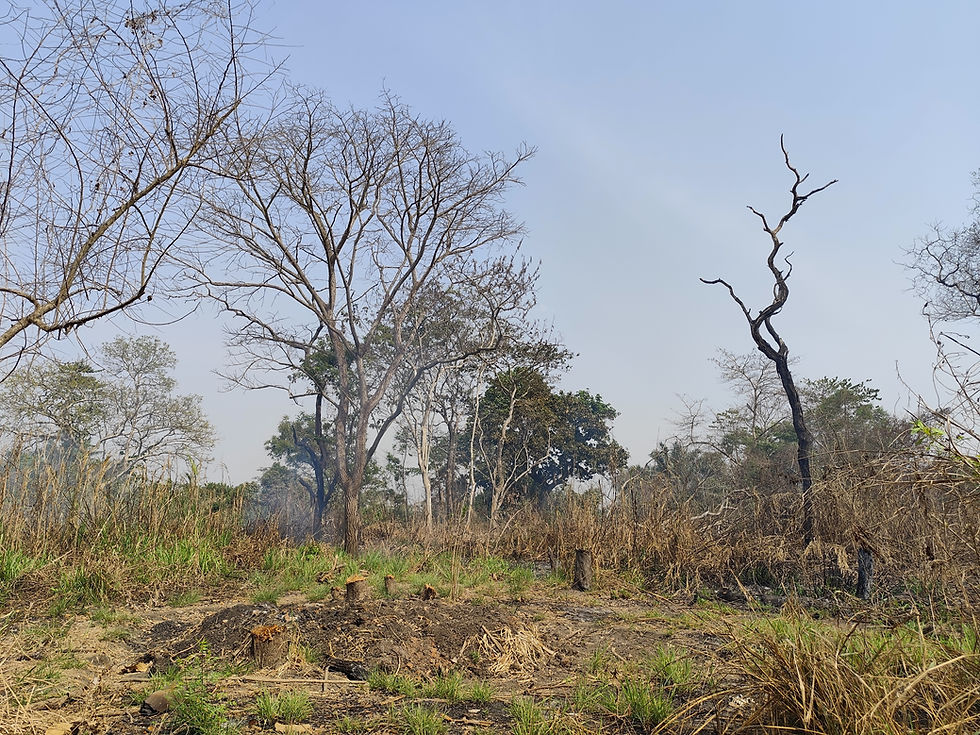
Logged trees burned for illegal charcoal production in Togodo Wildlife Reserve, Togo. Photo by Irene Di Lecce.
Even our time in Togodo Reserve was eye-opening: we discovered a patch of forest where trees had been cut, and some were still burning to produce charcoal. Kaboumba also got his foot stuck in a trap…luckily rusty and not sharp. Close to Togodo, we visited a hippo sanctuary where the manager had recently rescued a juvenile black kite with a broken wing and a python, both bought from poachers.

Rescued Black Kite at the hippo sanctuary close to Togodo Wildlife Reserve. Photo by Irene Di Lecce.

Rescued python at the same hippo sanctuary close to Togodo Wildlife Reserve, Togo. Photo by Irene Di Lecce.
On a cheerier note, I also experienced some funny situations. In Benin, in one of the villages we visited on the Ouémé River, some men were interested in knowing whether I was married. They quickly realized, however, that it wouldn’t be a match made in heaven, as I don’t speak French and they don’t speak English. Then in Ghana, I accidentally crashed a wedding at the hotel. I bumped into a security guard I met one night going back to my room at Mole National Park. He promptly invited me to sit at his table—to my horror, very close to the middle of the room and at the center of attention.

Baboons visiting the hotel in Mole National Park, Ghana. Photo by Irene Di Lecce.
In Mole National Park, we spent a few days in the company of Albert, a park ranger there. On our last day, he complimented me for my endurance in the field: he was surprised I was able to walk long hours in the heat without complaining even once, exactly like the men accompanying me. Appearances can be deceiving…

Mole National Park rangers including Albert, standing to Irene's right, and the IBCP team take a break from raptor surveys. Photo courtesy of Yendoubouam Kourdjouak.
From a personal perspective, I found Abiola, Kaboumba and Yendoubouam very welcoming and thoughtful. Their discussions sometimes seemed very heated, but always ended up in laughter—to my great surprise. They are a tight knit group, but by the second half of the trip, it felt like the ice was breaking, and they treated me as one of them.

Urban waste and egrets in Accra, Ghana, next to a slaughterhouse visited by Hooded Vultures. Photo by Irene Di Lecce.
Actually, they had no mercy in mocking me for my skepticism when they tried to educate me about the existence of witchcraft and evil spirits. My efforts to share my atheist/agnostic world view with them only managed to make them laugh even harder. Despite the cultural divide, we shared many good laughs. It was a pleasure to visit these countries in their company.

Counting raptors at Mole National Park, Ghana. Photo by Abiola Sylvestre Chaffra.
This trip also gave me the opportunity to appreciate how passionate Abiola, Kaboumba, and Yendoubouam are in their efforts to make a difference. The challenges they face are numerous, from illegal hunting stemming from poverty, lack of education and superstitious beliefs, to lack of funding and government support for environmental protection. I’m happy they can count on my help in disseminating the results of their hard work.

An endangered African savanna elephant in Mole National Park, Ghana. Photo by Irene Di Lecce.


Comments