
From the Field: Colin Jensen’s research on hunting impacts on hornbills in Cameroon

18 May, 2026
By Alex Trifunovic

Colin Jensen in Ebo forest, southwest Cameroon. Photo courtesy of Colin Jensen.
An avid birder, Colin Jensen earned his master’s degree in International Nature Conservation at the University of Göttingen in Germany. He collaborated with IBCP for his thesis project investigating the impacts of poaching for international trade on hornbill populations in the tropical forests of Cameroon. I spoke with Colin about his time in the field and his experience researching hornbills.

A pair of Black-casqued Hornbills (Ceratogymna atrata) in southwest Cameroon; the male is on the left and the female on the right. Photo by Colin Jensen.
What led you to pick International Nature Conservation for your master’s and why the focus on birds?
CJ: I did my bachelors in the US in Utah pretty close to home. I did some research in my undergrad on dragonflies, and I really liked the research. I also wanted to go outside of the intermountain Idaho/Utah bubble. The idea hadn’t come to me to go outside the US, and then I found this program that is split between Germany and New Zealand. A big contributing factor was that a master’s is much more affordable outside the US. As for the birds, I always knew I wanted to do something with birds. I started birding before I can remember, and even though my parents weren’t birders, they were supportive of my interests. A lot of our family vacations were partially bird related, and my parents were always willing to take me out birding. As part of my degree, I did an internship in Israel researching migratory birds in date plantations and that decided it for me. So I had always known, but then it was a couple experiences during my masters that really pushed me.

White-thighed Hornbill (Bycanistes albotibialis) in southwest Cameroon. Photo by Colin Jensen.
Can you give a brief summary of your project and research?
CJ: The focus of the project was on forest hornbills. We were trying to understand the connection between hunting pressure and hornbill distribution and populations. Until recently, hornbills in Cameroon were only occasionally hunted for bushmeat, but the project that IBCP did with Francis Guetse found that there was a new foreign market demand for hornbill casques. They recently published a paper on that. So, my project was looking at the impact and connection of that new market with hornbill populations.
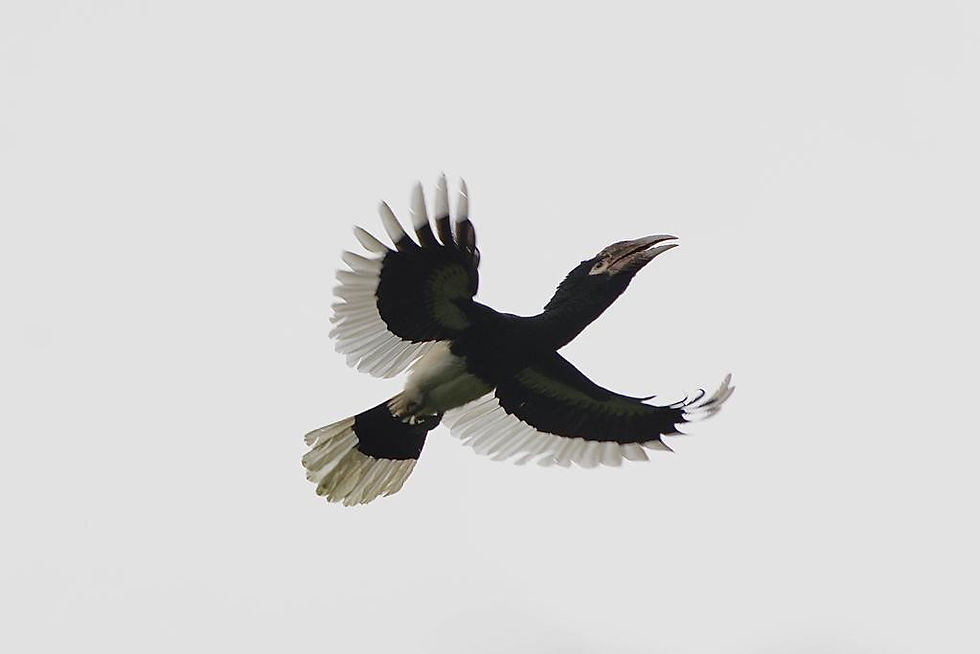
White-thighed Hornbill in flight, southwest Cameroon. Photo by Colin Jensen.
Did you find a connection between hunting and hornbill populations?
CJ: Simply put, there is a connection. The long answer is that the connection is complicated with factors both environmental and within the communities that affect hornbills. Our study was the first one looking at this connection, so the results are preliminary. We found that in certain situations, the impact is greater. In areas of higher altitude, the effect of hunting seemed to be stronger with a decrease in hornbill numbers. Again, it's kind of preliminary, but one of the ideas is that hornbills in high elevation areas are more naïve to hunters. Hornbills are super smart, so there might be learning and shifting behavior in response to hunting pressure.

Male Black-casqued Hornbill. Photo by Colin Jensen.
What did the prep work look like before traveling to Cameroon?
CJ: There was a lot of prep work, first and foremost coming up with the research plan and protocol. I hadn't done a project in Cameroon or with hornbills, and thankfully Nico has a wealth of knowledge there. First was coming up with what we want to do, then getting the research permits through the government. Then it was assembling gear and making contacts with people in Cameroon. A common theme for the project was having a lot of good people around me that helped me go through the processes easier than if I was trying to do everything on my own. One thing about planning for a place like Cameroon is that once you get there, everything gets turned on its head. You have the normal pitfalls of fieldwork, but in Cameroon they are magnified. I had three to four weeks when I got there to get to know people and the area, and those weeks were the most important planning I did. On the ground, stuff changes every year. A lot of the areas we worked in were difficult to access, and two big rainstorms can make them inaccessible. So a lot of planning beforehand, and then a lot of that got thrown out the window once we got there.

A view of Mont Nlonako in southwest Cameroon. Photo by Anya Dabite Abeh.
What did a typical day look like while doing your fieldwork?
CJ: I was in Cameroon for 4 months. When we were starting and between work, we were in an apartment in the capital city, but most of the time we were camping in tents 5-10km into the forest. A typical day would be waking up a little more than an hour before sunrise, making breakfast, getting ready, and walking to the first survey point by sunrise. Each survey point was 500 meters apart, so it was surveys and walking point to point until lunch, and then surveys again in the afternoon until sunset. In areas with rough terrain we would only do morning surveys, and sometimes we would only get the afternoons because of morning rain showers. In the forest once the sun sets it’s nice, but pretty boring, so I would usually go to bed early. Most places out in the forest, we had a field assistant, a local guide, and a camp manager that would stay back and cook while we were out. The food was usually a base of rice or plantains and then some sardines and dried fish, and occasionally beans. Our camp manager had some creative flexibility with spices, but it was generally pretty basic. After a long field day, you’ll eat pretty much everything!

The hornbill research team heading out to the field in southwest Cameroon, including (from left to right) Ambe Anya Willibroard, Elie, Tonny, and Colin Jensen. Photo courtesy of Colin Jensen.
What were some challenges you had to overcome?
CJ: Weather was the biggest challenge. I was there at the end of the rainy season into the beginning of the dry season, but the rainy season continued longer than normal. One of the first areas we went to do surveys, we had walked 5 or 6 km into the forest and there was a big river that was impossible to cross with the rain. We had all of the gear and people ready and then we couldn’t go there. Everyone kept saying the rainy season was over and then it just kept raining. The back end of the season was sunny and roads were clear, but at the beginning, the rain made access and doing surveys challenging. Sometimes you’d walk out into the forest, set up camp, and then the next day it would pour rain all day. Then you’re just sitting in your tent, there’s water in your tent, and there’s water outside. It made things a little difficult. People would tell me November was the dry season and it would get better, and I started thinking maybe dry season means something different here than it does to me, but come January there really was a dry season without much rain.

Female Black-casqued Hornbill preening. Photo by Colin Jensen.
What was the most surprising thing that you encountered?
CJ: Despite the pressures hornbills are facing from hunting, encroachment, and habitat loss, there were so many hornbills. Even in the villages without any native trees, they were there. I had a fear there wouldn’t be any, so I was surprised by how many there were. Seeing a lot does not necessarily mean they are doing well, but after hearing from Nico about her work in Ghana where they wouldn’t see some hornbill species at all, I felt very fortunate to see so many hornbills.

Yellow-casqued Hornbills (Ceratogymna elata). Photo by BOE2395, CC BY-SA 4.0, via Wikimedia Commons.
What are some of your favorite memories from the field?
CJ: The first forest area we were in had the possibility to see all the hornbill species except the Yellow-casqued Hornbill, since it was right on the edge of its range, and we didn’t end up seeing it for the first couple of months. So, when we moved to the second forest area just inside their range, me and the guy I worked with had hoped to see them but we were skeptical. On our first survey at the second area, we heard a call and then a beautiful Yellow-casqued Hornbill flew across the logging road we were on. We both looked at each other and almost started jumping up and down. We were so excited! We were over two months into the research and seeing hornbills every day, but it was still so cool to see this one we had been trying to see. That was definitely a standout moment for me. I had also always hoped to see chimpanzees, and on the last survey point in Ebo Forest, we heard a big commotion in the forest ahead of us. I didn’t see them, our guide did, but it was a big troop of chimpanzees. Just to know that I was in the same place as chimpanzees was so cool. It was also like a little goodbye at the end.

Chimpanzee (Pan troglodytes) in southwest Cameroon. Camera trap photo courtesy of Anya Dabite Anya.
What would be your advice to a visitor that has never been to Cameroon?
CJ: Be patient with yourself and the people you work with. Know that you will have an idea in your head of how things will go and that things will be a little different. There are things that will probably be easier and things that are more challenging than expected. Don’t put too much pressure on yourself to have an exact outcome. It’s an amazing place and an amazing experience, so try to enjoy it while you’re there.

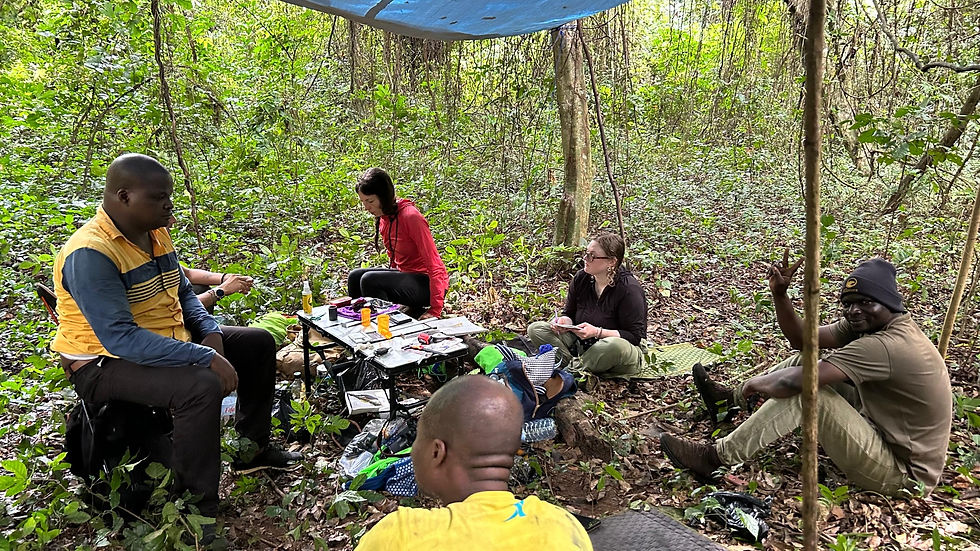
IBCP Cameroon fellow Anya Dabite Abeh meeting with traditional chiefs in Mont Nlonako, where he shared Colin’s results, discussed future collaboration, and gifted some IBCP T-shirts to thank them for their support. Photo courtesy of Anya Dabite Abeh.
Concluding note: You can learn more about Colin’s hornbill research findings from his report submitted to the African Bird Club, which generously provided funding for this project. Following Colin’s fieldwork, IBCP also made a video presentation including this research for the African Bird Club’s Annual General Meeting. Since finishing his master’s, Colin has joined the staff at Boise State University’s Intermountain Bird Observatory. African hornbills recently received CITES protection due to evidence of their declines and concerns about the impacts of hunting for international trade. A scientific article based on Colin’s research is currently in review, which IBCP looks forward to sharing once it is published!

IBCP Cameroon fellow Anya Dabite Abeh meets with traditional chiefs in the Ebo forest area to share Colin’s results and discuss future collaboration for hornbill research and conservation. Photo courtesy of Anya Dabite Abeh.


Comments