
Mist nets, fetish markets, and motorbikes: A field season in Benin

Updated: Sep 8
24 August, 2026
By Emma Ellis
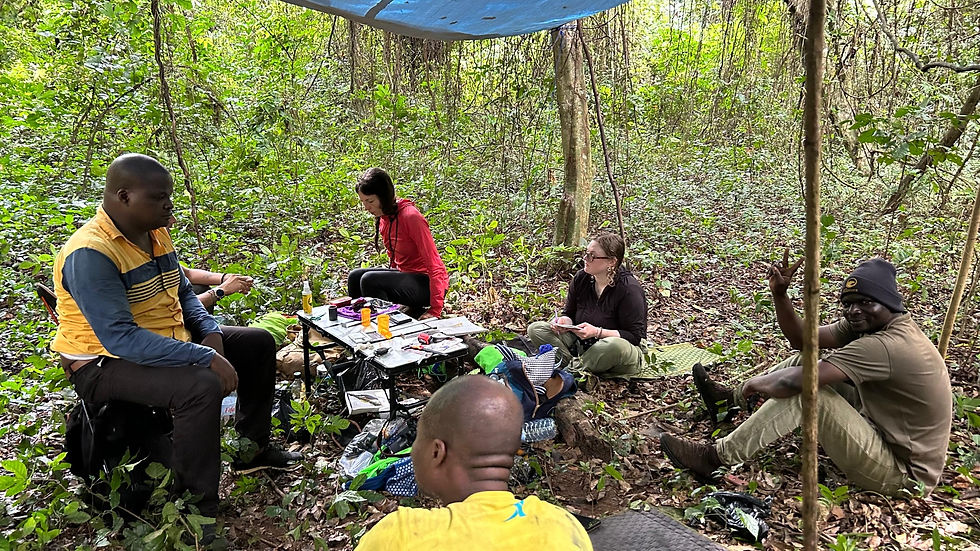
The IBCP team at our first mist netting station in Benin: Forêt classée de Pahou. Photo by Yendoubouam Kourdjouak.
From April 23 to July 2, 2026, I spent my first field season in Benin, West Africa, my first time on the continent beyond a family trip to Morocco. What followed was a month of mist netting in sacred forests, an unexpected survey through the fetish markets of Benin, and a crash course in adapting: to a new team, a new environment, new birds, and a whole new way of getting around.
I landed in Cotonou late at night, and the first thing I remember is the air. It was thick, warm, and completely unfamiliar, pressing in as soon as the plane door opened. I remember lying there that first night with a rush of anxious excitement, thinking about everything still ahead of me. This was the field season I had been waiting for, and it was finally happening.
It was really the next day, on the drive to Pahou, our first mist netting site, that gave me my first real look at the country, through the car window. People were everywhere: walking along the side of the road, selling peanuts out of old whiskey bottles, boiled corn held out toward passing cars, sleeping mats rolled up and balanced on sellers' heads. Goats, chickens, and pigs roamed loose everywhere, picking through whatever had fallen from the market stalls. And there were the buildings, too, raw concrete, many of them only half-built, with rebar and electrical cables sticking out of flat roofs, waiting for a second floor that might come someday. And then something caught my eye that I could not make sense of at first: big glass jars lit up in green, glowing like something out of a dream, lined up at little roadside stands. It took me a moment to realize they were filled with gasoline, fuel sold informally, mostly for motorbikes, the green light just a way to make it visible in the dark. Everything was like that, that first drive. Every direction I looked held something I had never seen before.

Roadside gasoline stand in Benin. Photo by Emma Ellis.
Finding My Marks
The first weeks were challenging. The heat and humidity, the noise, the smells, the food, the plastic waste everywhere, and birds I knew absolutely nothing about, flashing through the bushes in ways I was not yet trained to read. The tropical climate itself was something I had never experienced before: hot and humid all the time, we never really dried off. Clothes started to smell after just a few hours of wearing them, and stayed damp even by the next day. Camping in tents in the field meant no daily showers either, so we would go to sleep sticky from the day, and wake up the same way.
I had been sent to Benin as a mist netting specialist, and since I speak French, the idea was that I could communicate easily with our West African colleagues and help train them in mist netting technique. I was joining a team that already knew each other well: Stephanie and Paulo, a couple, from the US and Brazil respectively, along with Yendoubouam from Togo and Abiola from Benin. Stephanie, Paulo, and Yendoubouam had just spent two months mist netting together in Togo, at Fazao-Malfakassa National Park, and Abiola had joined them there too for part of that time. So while Benin was a brand-new mission for all of us, most of the team had already found their rhythm together, and I was the one adapting to it. All four of them already knew West African birds well and could identify species quickly in the field, something I still had to learn myself. On top of that, Stephanie and Paulo, quicker than the rest of us to call out an ID, did it in English, while the few species names I knew were in French. So at first, instead of actually looking at the bird in front of me, I would be scrambling to translate the name on my phone, and often missed the bird entirely by the time I had looked it up.
It was not just the names. Stephanie and Paulo had trained with a different mist netting protocol than I had: different measuring methods, different ageing and molting codes. Small things, but they meant adapting a skill I already had, in the English vocabulary of mist netting, while also translating it all into French for Yendoubouam and Abiola. That is actually one of the things I love about mist netting with people trained differently than I was: every new team teaches me another way of doing the same job.

African Grey Hornbill, one of the first birds I was able to spot and ID. Little did I know how many more I would end up counting! Pahou. Photo by Emma Ellis.
Sacred Forests and Mist Netting
Our original plan was two months of mist netting comparing Benin's sacred forests with Benin's forêts classées, state-protected forests. In the end, only one month was needed. All the sites we surveyed were in the south of the country: Pahou, sacred forests like Kouvizoun Adakplamè-Ewé near Kétou, Kodjizoun and Siligbozoun near Porto-Novo, and the vast Forêt classée de la Lama, the largest natural forest block left in the region. Our goal was to study the bird communities there. Mist netting is especially good at catching the skulking, hard-to-see species that live low in the bushes, more like little mice than birds. Greenbuls, Bristlebills and Sunbirds made up a large part of what we caught.
I still remember the smell of those forests. It is difficult to describe: incredibly damp and earthy, with something almost sweet and slightly rotten underneath. It clung to everything, and before long that smell simply became what "forest" meant to me in Benin.
The forest floor felt alive in a way I had never experienced before. We happened to arrive during the centipedes' mating season, and they were everywhere, huge centipedes winding their way across the leaf litter. It was one of the first moments that really made me stop and think: I am actually in a tropical forest. That, and the birdsong all around us, obviously, though it took a while before any of it started sounding familiar.

Paulo and Stephanie helping me with my first tropical bird in the hand, Pahou. Photo by Yendoubouam Kourdjouak.
Those first days were humbling. I could hear birds all around me, but I could barely see any of them through the dense vegetation. I remember Stephanie and Paulo suddenly getting excited over the song of a Sabine's Puffback, while I was still trying to work out which sound they were even listening to. Funny enough, we never heard that species again for the rest of the trip. Before long, though, the explosive, melodic song of the Little Greenbul became one of the sounds I most associated with those forests, and I grew especially fond of the Blue Malkoha's distinctive whistle, speeding up into a rapid trill. And whenever I heard the Black Cuckoo, all I could think was that it sounded like it was singing "I am so saaaad.”
I still remember my very first bird in the net: a Snowy-crowned Robin-chat. I was ridiculously excited. I knew I had seen it in my field guide before and could remember there was something "snowy" about its name, but I could not remember the rest of it. It felt like the perfect reminder of just how unfamiliar this whole avifauna was to me. But I was lucky to have good teachers close by, patiently walking me through it, bird by bird.

The Snowy-crowned Robin-chat itself, my very first bird in the net, Pahou. Photo by Emma Ellis.
Mist netting in a tropical forest is its own physical education. Cutting the net lines meant pushing through spiky vines that grabbed onto your clothes and, more than once, ripped straight through them. You also had to watch every single step, because the forest floor could hide a swarm of ants, and if you put a foot wrong, they would be climbing your leg and biting within seconds. The worst was when a swarm decided to hunt directly under one of our nets while we still had a bird caught in it. Having to reach in and extract the bird while ants swarmed up my body was something I had genuinely never thought to prepare for. But eventually I learned that those swarms brought their share of birds too: species that follow the ants around, either foraging on them directly or picking off the insects the ants scare into the open as they move.
Beyond the ants and the vines, the forests themselves were not always cooperative. Some of the sacred forests turned out to be swampy and inaccessible, since the rainy season had just started; others were too degraded, stripped of the understory vegetation that these birds depend on. That is why the survey ended up running one month instead of two.
Working in the sacred forests came with its own challenges, too, tied to their proximity to villages. Everyone nearby was aware of our presence, and in one forest, Bamèzoun, near Porto-Novo, we ran into what felt like real trouble at the time. The forest is claimed by two different villages, and we had only informed one king of our presence, something we had not even known ourselves, since our guides from the first village had never mentioned the dispute at all. When we arrived the next day to start mist netting, villagers from the other village, the one that had no idea we were even there, came to bring Abiola before the king to explain what we were doing there. At one point, fifteen men showed up, all arguing over whose forest it actually was. On top of all that, this forest was already proving hard to access, and it turned out there was a whole ritual just to be welcomed in at all. Before we were allowed to enter, we watched an entire sacrifice ritual unfold in front of us: statues covered in corn flour and red palm oil, then shells thrown to the ground and read for an answer, a way of asking the forest spirits whether we could enter, and even whether we could wear shoes, normally forbidden there. I remember standing very still, not quite understanding what I was watching but feeling, very clearly, that our whole presence in these sacred forests depended on how those shells landed (and, let's be honest, on the "offering" we would make). It was unsettling in a way I had not expected, to have our presence in a forest decided by something so far outside anything I knew.

The sacred forest at Bamèzoun, where the entry ritual took place. Photo by Emma Ellis.
Bamèzoun was not the only site with its own complications. At Kouvizoun, we could hear chainsaws running nearby while we mist netted, and found ourselves setting up close to traps for small mammals, not something you want next to a mist net. At Siligbozoun, cattle roamed freely through the forest. Our guides had to promise to keep them out of the area for the days we worked there, and, to our genuine surprise, they actually managed it.
I had imagined sacred forests as small, protected pockets of undisturbed nature, little heavens. Instead, most were pretty used by humans: hunting, wood cutting, agriculture, cattle herding. Even the forêts classées, patrolled by government forest guards, were not quite what I expected either, mostly huge plantations of teak grown for timber, with just a patch of natural forest sitting in the middle.
One thing that struck me the whole time was how skittish the wildlife was. Back home, or really anywhere I had birded outside of a big city, you can usually approach a bird slowly and carefully and get fairly close before it moves. There, almost everything spooked at the slightest thing, birds and mammals alike, bolting or flying off long before we got anywhere near. It said a lot, without anyone needing to tell me, about how present humans are in these landscapes: people finding whatever they can to make a living, understandably, but leaving very little room for the wildlife that is still trying to hold on there.
Human pressure was not the only force shaping that landscape, though. The weather had its own say too, and that month was when I really started to understand what a rainy season in the tropics actually means. The storm at Lama was the clearest example. It hit just as we were taking down the nets one morning, soaking us to the bone almost instantly and flooding the clay road within minutes, bringing down a massive tree across our path. We had to get out with machetes and cut our way through before we could drive on. We found out later that same storm had caused severe flooding all the way in Cotonou that day.

Our second mist netting camp at Lama, tarp up and ready in case the rain came, Forêt classée de la Lama. Photo by Emma Ellis.
Camping through that season taught me its own rhythm. It was always too hot to sleep with the tent cover on, so we left it off most nights, but we still had to keep it within reach in case rain came. It happened more than a few times: raindrops landing on my face would wake me up, and within seconds I would be up, clipping the cover into place, then back asleep like nothing had happened.
The month had its share of memorable detours, too. On the road between sites, we stopped along the Ouémé River and spotted three rare Egyptian Plovers, picking their way along the sandbanks just a few meters from women doing their laundry and kids playing in the water. During a stop for Global Big Day, on the 9th of May, Stephanie and Paulo took us to the Plaine de Sô, a stretch of wetland crossed by a busy sand road and surrounded by sand mines, where we spotted the rare Anambra Waxbill among many other beautiful wetland species, like the well-known African Jacana and the Blue-headed Coucal.

The Ouémé River and its Egyptian Plovers, and the Plaine de Sô, home to the rare Anambra Waxbill. Photos by Emma Ellis.
The Fetish Markets
When the first month's mist netting wrapped up earlier than planned, the team had to figure out what to do with the second month. Stephanie, Paulo, and Yendoubouam, went with the car to Côte d'Ivoire to scout potential mist netting sites there, while I stayed in Benin to help Abiola with his ongoing raptor and hornbill survey in the country's fetish markets, and also to scout sites of our own.

Azovè fetish market. Photo by Emma Ellis.
Nothing quite prepares you for those markets. The smell hits first, pungent and inescapable, the kind that clings to your clothes and hair long after you have left. Then the sight: thousands of dead birds, mammal heads, dried reptiles, laid out across stalls and the flat, round baskets typical of the markets, alongside a handful of live animals, black kites, chameleons, pythons, waiting to be sold. I remember walking through the first one in a kind of numb silence, trying to hold a scientific distance and failing. It was only after I stepped back out that I realized I had been holding my breath almost the whole time, without noticing, partly the smell, partly just the horror of what I was looking at. What disturbed me most, at first, was how normal it all felt for everyone else. Kids were playing in the alleys between the stalls. A little further on, teenage boys were cutting open dead hedgehogs and filling them with syringes of formalin. Older men sat quietly in the back of their stalls, and right next to them, women prepared oranges, slicing off the bitter skin with a razor blade, going about an ordinary day surrounded by all of it. Over the following visits, I got used to it too, enough to hold real conversations with some of the sellers, something that had felt completely impossible to me at first.

The typical market baskets filled with hornbills, owls, cuckoos, plantain-eaters, spurfowls, weavers, and more, at Zounzonme fetish market. Photo by Emma Ellis.
Abiola's work involves counting raptors and hornbills across markets, recording the number of sellers and stalls, and how many carry these birds. I took on the hornbill count, which was more manageable, only a handful of species to identify, for the most part: African Grey, West African Pied, Piping, and Northern Red-billed Hornbills.
But two finds stood out: four Black-casqued Hornbill heads and one White-thighed Hornbill head, species that do not occur in Benin at all. They must have been hunted somewhere within their actual range, like in Central Africa, and transported a long way to be sold in these markets. It was a stark reminder that this trade does not just draw down Benin's own wildlife; it pulls in birds from far outside its borders, feeding demand across a much larger region than most people would probably assume. I was actually already aware of this, from a paper I had worked on about vultures poached in Chad, likely destined for these same kinds of markets in Benin and Nigeria. But knowing it on paper and standing in the middle of it were two very different things.

A typical fetish market stall, mammal heads, dried reptiles, and birds, and a very unconvincing "leopard" head on the far left, at Klouekanmè fetish market. Photo by Emma Ellis.
Some of what was sold in those markets was not even what it claimed to be. Sellers would sometimes completely disguise a species: shaving the head of a Black Kite so it looked like a vulture, or painting spots on a dog's head and calling it a leopard. At one of the markets, I noticed a strange-looking bird, a Piapiac with white feathers across its chest, which stopped me completely, since no bird I knew looked quite like that. After texting Stephanie and Paulo for help, we figured out the white feathers had been glued on. At a different market, where a few of the sellers happened to be especially friendly, I jumped on the occasion to actually ask why. Normally a fake is built to resemble a real, more valuable species, but there is no black bird with a white front that this could have been passed off as. They laughed and said they had no real reason either, that their fathers had done it before them, so they kept doing it too. Then one of them said something in the local language, which Abiola understood. He explained afterward that they had told each other not to say it too loudly, or the market chief would hear and get angry.

The Piapiac itself, with white feathers glued to its chest and discolored beak, with a female African Grey Hornbill, Northern Red-billed Hornbill, owls, and other birds. Klouekanmè fetish market. Photo by Emma Ellis.
As unpleasant as the markets were, the survey work sharpened my identification skills fast. Seeing so many species up close, even as specimens, trained my eye in a way that paid off later, once we started scouting the forests further north. Birds like the White-breasted Cuckooshrike, the White-shouldered Black Tit, and the Yellow-fronted Tinkerbird, ones I might have struggled with a month earlier, were suddenly familiar.
The Prospecting Trip
For the rest of the month, Abiola and I prospected several forests further north, in the center of the country, this time, for potential mist netting sites: Bassila, Pénessoulou, Kikélé, and the “new” Wari Maro–Monts Kouffé reserve. Wari Maro and Monts Kouffé themselves are more savanna than forest, roughly half and half, with gallery forest following the rivers and streams. These forests sit at roughly the same latitude as Togo's Fazao-Malfakassa National Park, where a mist netting project has already run for the last two dry seasons.

Inside the natural part of the Forêt classée de Bassila. Photo by Emma Ellis.
There is a real reason for that comparison with Fazao beyond just the shared latitude: these forests were likely part of the same forest block thousands of years ago, before a stretch of savanna called the Dahomey Gap split West Africa's forests from those further east. It is a small thing to think about while walking through the trees, that the forest under your feet might once have connected all the way to Togo. Wari Maro and Monts Kouffé are also on track to become a national reserve, largely because a few elephants and buffalos still survive there, though right now the area is under heavy human pressure: logging, farming, and more, all of it illegal inside the park boundary. So good survey data now could genuinely help shape how it gets managed.
Just getting between these sites took most of a day each time, always by taxi: Bohicon to Bassila, Bassila to Pénéssoulou, Pénéssoulou to Bétérou, Bétérou back to Bassila, Bassila to Prékété, Prékété to Banté, and finally Banté back to Bohicon… In total, all of that driving added up to more than twenty hours on the road, in taxis so old and overloaded that once, Abiola and I were two of ten people crammed into a five-seat car, the trunk and roof piled high with bags and objects of every kind.

Nine of us in one taxi, four in front, five in the back, and the roof loaded. Photo by Emma Ellis.
Once we actually reached a forest, the taxis stopped and the motorbikes took over, since nothing else could handle the tracks inside, each of us riding behind a local guide. It was actually my first time back riding and Abiola kept worrying I would be uncomfortable on those motorbikes, or worse, that I would get hurt, but I ended up loving all of it, even the cramped taxis.
That worry made more sense once we got inside Wari Maro and Monts Kouffé. Since we were doing this prospection in the middle of the rainy season, the tracks were rough and slippery, the sandy paths turned wet and treacherous, and our drivers slipped more than once, Abiola's especially. My own guides always seemed a little more cautious with me. Some areas were simply too wet or the tracks too degraded to reach at all. One river crossing at Monts Kouffé became impassable after a single morning of heavy rain.
That morning stayed with me. We arrived at the marigot, the local word for the river, right as a truck was being repaired there, a group of young men waiting to cross into the park to collect timber that had already been illegally cut down. When the rain came down hard, we ended up sheltering together, underneath their truck, waiting it out. There was something strange about it: taking shelter with the very people who might have cut down the tree where a pair of Piping Hornbills had been nesting, or something just like it. We spent almost an hour there, and then a second truck arrived, also headed across the river. Most of the men were from the south of Benin, far from Monts Kouffé themselves, and we ended up talking for a while. They explained the wood they were collecting was headed mostly for China.
At some point, they noticed my binoculars, and their curiosity took over. I let a few of them try, and suddenly the same men I had felt intimidated by, the only woman among twelve, a foreigner on top of it, turned into excited kids discovering something new. In the end, we had to abandon the park visit that morning altogether, something that would not have happened in the dry season. It was frustrating, too, a clear sign of how much of the park we were missing: in drier conditions, we could have gone much deeper in, but as it was, we only ever saw a fraction of what is there.

The mood shifts: the men we had sheltered with under their blue truck, taking turns with my binoculars, Monts Kouffé. Photo by Emma Ellis.
The pressure on these forests is real and visible: logging, cattle herding, charcoal production, and karité (shea) collection. But the sheer number of birds we encountered while prospecting was striking, and it left me hoping this future survey work can help make the case for protecting what is still there. I still remember the small rush every time we found a species I had not seen yet, quickly pulling up Merlin to confirm it, a Red-cheeked Cordonbleu, a Striped Kingfisher, or finally seeing a White-shouldered Black Tit alive after only knowing it from the markets.

The many faces of human pressure on Wari Maro and Monts Kouffé: logging, timber transport, cattle herding, and karité collection. Photos by Emma Ellis.
But not every best memory from those weeks was about birds. At Pénéssoulou, our camp sat next to a massive colony of African fruit bats, spread across the trees for more than three kilometers, probably hundreds of thousands of them. As the day started to set, they lifted off gradually, more and more of them taking flight, until wherever you looked there were thousands of bats filling the sky, the females calling loudly with their young clinging to them. The sound alone, thousands of wingbeats and calls, was everywhere, all night long. I actually had trouble falling asleep with them that loud so close to the tent.
A different kind of moment stayed with me at Kikélé. It is the last sacred forest in Benin known to hold the endangered White-thighed Colobus, and we saw three of the roughly 34 individuals left in that tiny 13-hectare patch of forest. There was a strange, quiet weight to that moment, watching an animal that has almost nowhere left to go.

Two teenage White-thighed Colobus (Ursine colobus), at Kikélé sacred forest. Photo by Abiola Sylvestre Chaffra.
Moments like those felt like a privilege, almost outside of time, but other encounters brought me straight back to reality. In the south of Monts Kouffé, I was struck by the sheer amount of freshly cut trees we kept passing. Then, driving along, we heard chainsaws running nearby, at least three engines going at once, though we could not see anyone yet. Our guides that day were part of a local collective that helps protect the forest, and they decided on the spot to go find whoever was cutting and confiscate their equipment. By the time we made it back to the motorbikes, three men were standing there with a single chainsaw, handing it over without a word of protest. One of them even helped strap it carefully onto the back of the motorbike. The whole scene felt strange, almost staged. We later learned that loggers like these are, in a way, tacitly authorized by the forest guards themselves, who likely get something out of it too. I could not tell if what we had witnessed was genuinely how these things get resolved out there, or some kind of performance for us. I will probably never know.

Crossing a river in Monts Kouffé. Photo by Emma Ellis.
Looking Back
Back during that first month, being able to speak French with Yendoubouam and Abiola meant we grew close fast, and that made it easy to talk about almost anything. We covered lifestyle, beliefs, the differences between France and West Africa. Some of what they shared, especially the more mystical stories tied to their beliefs, stretched my sense of what I could easily accept as real, but I loved hearing it anyway. I was also curious, if a little hesitant to ask at first, about how France is seen there today, after everything that came before with colonization. They were always happy to answer, never made me feel silly for asking. And it was not just them. Pretty much everyone I met in Benin along the way was like that, welcoming in a way that made me feel almost at home, even though it looked nothing like home.
One memory that will stick with me is the "Yovo, Yovo" calls. Yovo is what people call white foreigners in this part of West Africa, and kids would shout it at me wherever I went, sometimes breaking into a little song: "Yovo, Yovo, bonsoir! Ça va bien, merci!" What I remember most is not just the sound of it, but the brightness in their eyes every time, like it was the best joke in the world. I heard it so often it became one of the soundtracks of the whole trip.

Yellow-mantled Widowbird in Benin. Photo by Abiola Sylvestre Chaffra.
Then, during the second month, I spent it almost entirely with Abiola. There is a particular kind of closeness that comes from being tired, dusty, and slightly lost together, day after day, in taxis and markets and forests neither of us had seen before. By the end of that month, Abiola felt less like a colleague and more like a close friend.
I arrived overwhelmed, translating bird names in my head and unsure where I fit into a team that already knew how to work together. By the end, I was identifying species confidently in the field, riding on the back of a motorbike without holding onto anything, the true "African way," as Abiola liked to call it, and holding my own in markets that had, at first, completely thrown me. It was not the field season I expected. The mist netting plan changed, the team split, and I ended up somewhere I never anticipated, counting hornbill heads in a market instead of birds in a net. But that, in the end, is what made it worth writing about.

Showing off my “African way” back riding skills. Photo by Abiola Sylvestre Chaffra.
Thank you, Paulo, for your eagle eyes and fast identification, which let me see far more birds than I ever would have alone. Thank you, Stephanie, for your rigor and steady management in the field. I truly look up to women like you in such a male-dominated world. Thank you, Yendoubouam, for the talks, the laughs, and the delicious peanut stew. And a special thank you to Abiola, for an unforgettable month; even five thousand words could not capture everything we lived through together. Thank you, too, for introducing me to télibo (a dough made from dried yam flour) with peanut sauce, your favorite dish, which quickly became mine as well. I have been craving it ever since I got home. And thank you, Nico and IBCP, for this opportunity, which genuinely opened my eyes to what conservation actually looks like in a place where so many other things come first, and left me even more motivated for whatever comes next.

A pair of Chestnut Wattle-eyes (male at left, female at right) captured and released at the Forêt classée de la Lama. Photo by Emma Ellis.


Comments